 FlavorAtlas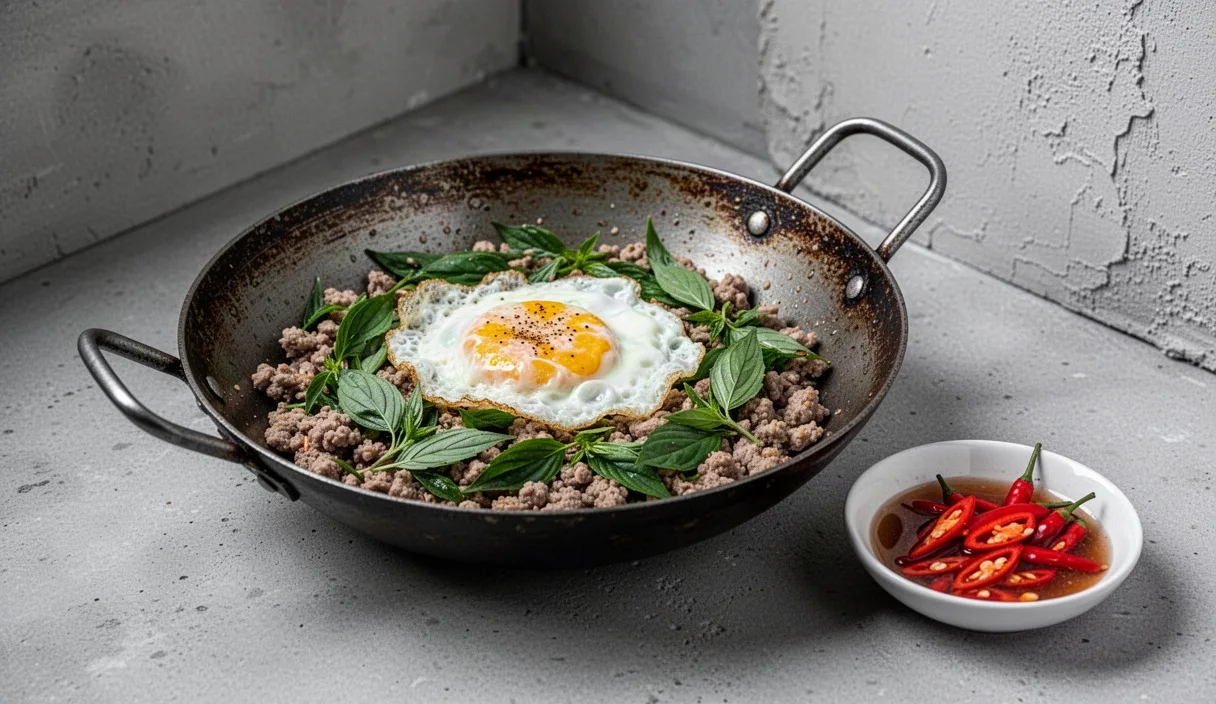
Pad kra pao requires heat, pungent holy basil, and coarse mortar-crushed aromatics. The dish fails when treated as a slow stir-fry or when sweet Italian or Thai basil substitutes for the peppery herbal bite of genuine Ocimum tenuiflorum. Street vendors across Bangkok run high-pressure cast-iron burners reaching 45,000 to 100,000 BTU, vaporizing thin soy sauces and flash-frying aromatics in under 90 seconds.
Replicating this profile on a residential stove demands strict heat management. Standard kitchen burners put out between 7,000 and 15,000 BTU, meaning you cannot rely on burner power alone to maintain stir-fry temperatures. You must manipulate thermal mass, control oil volume, minimize moisture in the protein, and select the correct basil variety.
Holy basil versus sweet Thai basil
Holy basil, known in Thailand as bai kra pao, belongs to the species Ocimum tenuiflorum. It is genetically distinct from Thai sweet basil, known as bai horapha, which belongs to Ocimum basilicum var. thyrsiflora. Holy basil carries high concentrations of eugenol, giving it an astringent, peppery aroma reminiscent of cloves, camphor, and mint. Thai sweet basil contains high levels of estragole, which produces an anise, licorice-heavy sweetness suited for green curries rather than dry stir-fries.
Using sweet Thai basil creates a fundamentally different dish called pad horapha. If you cook sweet basil with the heat levels and savory profiles of pad kra pao, the sweet notes clash with the heavy fish sauce and garlic base. Italian sweet basil performs even worse, turning slimy and releasing excessive moisture upon contact with oil.
| Characteristic | Holy Basil (Bai Kra Pao) | Thai Sweet Basil (Bai Horapha) |
|---|---|---|
| Botanical Name | Ocimum tenuiflorum | Ocimum basilicum var. thyrsiflora |
| Primary Volatile | Eugenol (clove, warm pepper) | Estragole (anise, licorice) |
| Leaf Texture | Thin, serrated edges, fine hairs | Glossy, smooth, thicker cuticle |
| Stem Color | Muted green or reddish purple | Deep, prominent purple |
| Thermal Response | Wilts in 6 seconds, releases aroma instantly | Resists wilting, requires 20 seconds to soften |
Source red or green holy basil from Southeast Asian markets. Red holy basil tends to have smaller leaves, stronger woody stems, and a more aggressive pepper note than the white-green cultivar. Store the leaves unwashed at room temperature in a perforated plastic bag. Refrigerating holy basil below 10 degrees Celsius turns the leaves black within 18 hours due to chilling injury.
Pan temperature benchmarks for home stoves
Achieving wok hei on an ordinary kitchen range requires high surface temperature before ingredients touch the metal. You need an initial pan surface temperature between 230 and 260 degrees Celsius. Above 260 degrees, standard cooking oils break down instantly into acrid smoke; below 230 degrees, ground or minced meat sheds water faster than the pan can evaporate it, braising the meat in its own juices.
Use a 14-inch flat-bottom carbon steel wok made from 1.5mm to 2mm thick steel, or a 10-inch heavy cast-iron skillet. Thin stamped steel woks lack the heat retention to withstand the addition of room-temperature meat on a residential burner. Nonstick pans must not be used, as their coatings degrade rapidly above 260 degrees Celsius and release harmful fumes.
- Preheat duration: Heat the dry pan over maximum heat for 3 to 4 minutes until faint wisps of smoke rise from the bare surface.
- Oil addition: Add 2 tablespoons of oil with a high smoke point, such as refined peanut oil, soybean oil, or rendered pork lard. Swirl to coat the sides. The surface will show shimmering micro-ripples instantly.
- Surface recovery: Adding 150 grams of meat drops the pan surface temperature by 40 to 60 degrees Celsius. Keep the burner on maximum output throughout the entire process to drive recovery.
- Batch restriction: Never cook more than 200 grams of meat at a time in a residential pan. If cooking for two people, prepare the dish in two separate passes.
Garlic and bird eye chile paste ratios
The aromatic core, known as prik kra-tiam, relies on a defined balance between fresh chiles and garlic. For a standard 180-gram portion of meat, use a weight ratio of 3 parts chiles to 4 parts garlic. A standard home portion uses 15 grams of Thai bird eye chiles (roughly 6 to 9 chiles) and 20 grams of garlic (roughly 5 to 7 cloves).
Choose small-clove Thai garlic (krathiam thai) when available. These cloves have thin papery skins that can be left intact, adding texture and sulfurous compounds that resist burning. If using large Western garlic cloves, peel them completely and cut away the woody root ends.
Pound the aromatics using a heavy granite mortar and pestle. Do not use an electric food processor. Blades slice cleanly through cells without exerting pressure, creating a pool of liquid that splatters and steams in the pan. The blunt crushing force of a granite pestle fractures cell walls, blending the allicin from the garlic with the capsaicin-rich oils of the chile into an aromatic paste without excess free moisture.
To reduce pure heat while retaining bright red visual contrast, substitute two of the bird eye chiles with one-quarter of a fresh red spur chile (prik chee fah) or red serrano. Pound the bird eye chiles and garlic first until coarsely broken, then add the milder chile for the final three strikes of the pestle.
High heat sear sequence
Prepare the seasoning sauce in a small dish before igniting the burner. Mix 1 tablespoon of fish sauce, 1 teaspoon of light soy sauce, 1 teaspoon of dark sweet soy sauce (see ew dam), 1 teaspoon of oyster sauce, and 1/4 teaspoon of white sugar. Having the sauce ready prevents delays that cause aromatics to burn.
Flash-fry the aromatics
Drop the crushed chile-garlic paste into the hot oil. Move the paste continuously across the bottom and lower walls of the pan using a metal spatula. Maintain vigorous movement for 8 to 12 seconds. The garlic should turn pale golden without browning heavily, releasing sharp vapors that irritate the throat. If the garlic turns dark brown, discard it and restart; burnt garlic ruins the sauce base.
Sear the protein
Toss in 150 to 180 grams of hand-minced pork shoulder or flank steak. Spread the meat flat against the steel surface in an even layer. Let it sit untouched for 12 to 15 seconds to establish contact browning before stirring. Break up any clumps with the edge of the spatula. Toss rapidly over high heat for 45 to 60 seconds until the meat is roughly 80 percent cooked through and liquid pooling has vanished.
Deglaze along the perimeter
Pour the sauce mixture directly onto the bare, hot steel around the perimeter of the pan, not directly onto the meat pile. The sauce should sizzle, foam, and reduce instantly against the metal, developing roasted caramel notes within 3 seconds. Rapidly fold the meat through the reducing sauce to coat the proteins evenly.
Incorporate the holy basil
Turn the burner off completely. Immediately dump 25 to 30 grams of whole holy basil leaves (roughly two packed cups) into the pan. Fold the hot meat over the raw leaves for 6 to 8 seconds using residual pan heat. The leaves must darken, wilt to half their volume, and release their aroma without shriveling into black, flavorless shreds. Transfer the contents to a plate immediately.
Crispy fried egg technique
A proper serving of pad kra pao requires a Thai-style fried egg, or kai dao. This is not an over-easy egg cooked in butter. It is deep-fried in high-heat oil until the edges become lacy, brittle, and deeply browned, while the yolk remains fully liquid and warm.
- Pour neutral cooking oil into a small wok or 8-inch skillet to a depth of 1.5 centimeters (roughly 80 to 100 milliliters). Heat the oil over medium-high heat until it reaches 185 to 195 degrees Celsius.
- Crack one cold large egg into a small ramekin to ensure the yolk is intact and ready for smooth release.
- Tip the egg gently into the center of the hot oil. The egg whites will instantly puff into a bubbling white raft with jagged perimeter bubbles.
- Immediately tilt the pan slightly and use a metal spoon or ladle to baste the hot oil over the raw white surrounding the yolk. Avoid pouring oil directly over the top of the yolk if you prefer a bright yellow-orange presentation. Baste the whites continuously for 35 to 45 seconds.
- Check the underside perimeter. When the fringe turns dark amber-brown and rigid, lift the egg using a slotted spoon or spatula. Hold it above the pan for 5 seconds to drain excess oil, then lay it directly over warm jasmine rice alongside the stir-fried meat.
Common mistakes
Small errors in timing and preparation compromise the texture and flavor of this dish. Avoid these frequent missteps:
- Overcrowding the pan: Cooking 400 grams of meat on a residential burner drops temperatures below boiling point. The meat releases juices, turns grey, and develops zero char.
- Pureeing aromatics: Processing garlic and chiles in a food processor extracts cell juice, creating steam pockets in the oil and causing the garlic to burn before the chiles soften.
- Pre-cooking the basil: Adding holy basil while the stove burner is on high drives off the volatile eugenol, leaving behind a bitter, grassy taste.
- Using commercial ground meat with high water content: Pre-packaged fine-ground meat packed in saline solutions sheds water instantly. Hand-mince whole pork shoulder or beef cuts with a heavy cleaver instead.
- Stirring the egg: Moving or flipping the kai dao breaks the structural blisters on the underside, resulting in a greasy, rubbery egg instead of a crisp edge.
Prep sequence for your next cook
Organize your counter before applying any heat. Have the meat hand-chopped to a coarse texture (roughly 3mm to 5mm pieces) and dried of surface moisture with paper towels. Pound the chile and garlic paste, measure the sauce components into a single ramekin, and pluck your holy basil leaves from their woody stems.
Heat your skillet or wok for the crispy egg first if using one pan. Fry the egg, rest it atop the plated rice, carefully pour off all but 2 tablespoons of the hot frying oil, and return the pan to the burner on maximum heat for 60 seconds. Once the steel reaches 240 degrees Celsius, run through the aromatic, meat, sauce, and basil sequence without pausing. Plate the stir-fry alongside the egg and eat immediately.