 FlavorAtlas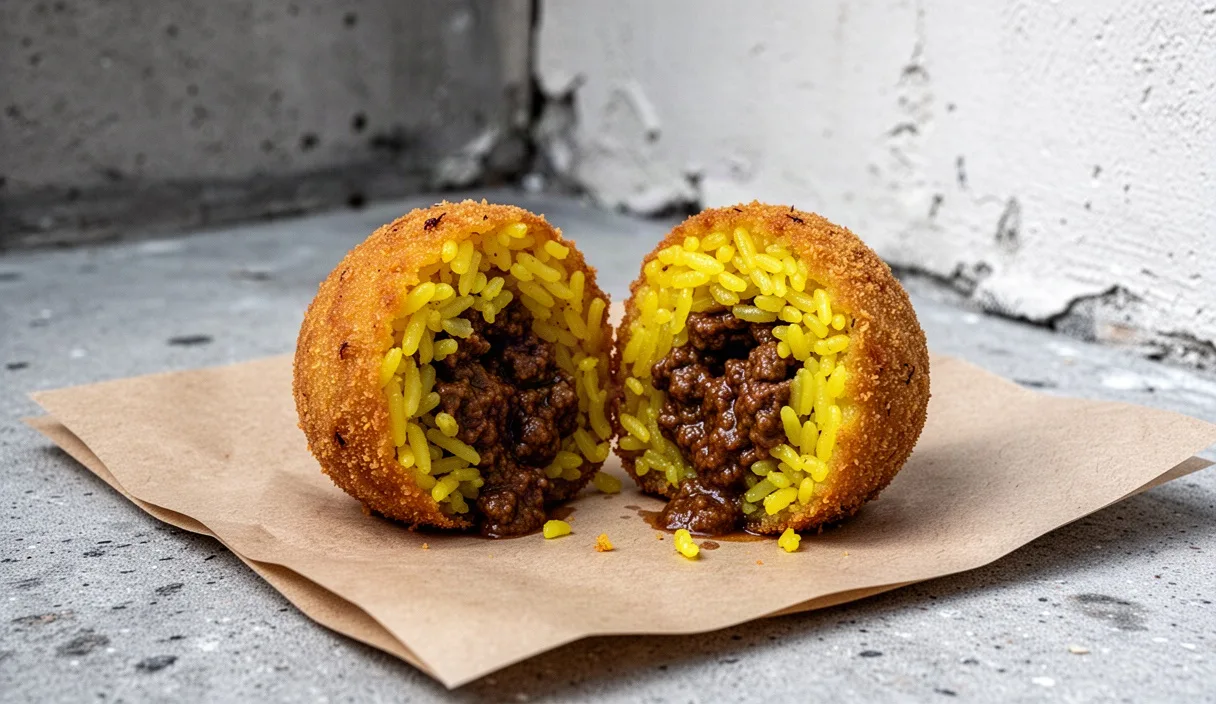
Palermo arancine demand structural discipline. A round ball of fried rice weighing 220 grams cannot collapse under its own weight or burst open in boiling oil. Sicilian street vendors solve this mechanical puzzle through precise starch gelatinization, slow-cooked fillings with minimal water content, and a specific flour batter that seals the outer sphere before it hits the fat. Every element balances structural stability against eating texture.
Get the grain right first. Sicilian arancine differ fundamentally from eastern Sicilian arancini, which are often conical and built on different ragu bases. In Palermo, the shape remains spherical, referencing the orange fruit (arancia) from which it takes its name. The interior rice must stay distinct enough to chew, yet sticky enough to shape around cold meat sauce without cracking. Missing this balance by adding too much liquid or using the wrong cultivar ruins the batch before you shape a single ball.
Rice variety and cooking starch balance
Select medium-grain rice with high amylopectin content. Carnaroli and Vialone Nano work best, though Roma remains the traditional budget standard in western Sicilian bakeries. Long-grain indica varieties like basmati or jasmine fail completely because their high amylose content keeps grains loose, dry, and incapable of binding. Conversely, round sushi rice creates a gluey paste that turns gummy inside the fried shell. Carnaroli offers roughly 24 percent amylose, providing enough surface starch to stick while the core retains structural tooth.
Cook the rice using absorption, not draining. Boiling rice in excess water and pouring it through a colander washes away the surface amylopectin needed to bind the sphere without eggs. Use an exact liquid-to-rice ratio by weight. For 1000 grams of Carnaroli rice, measure 2200 grams of light broth or water. Add 15 grams of fine sea salt and 0.5 grams of powdered saffron to the cold liquid. Saffron supplies the signature golden hue and a subtle earthy note that cuts through the upcoming dairy fat.
Bring the liquid and rice to a rolling boil together in a wide, heavy-bottomed pan, then drop the flame to low. Cover the pot and let the rice absorb the liquid over 14 to 16 minutes without stirring. Agitating the pot during cooking ruptures the grain walls prematurely, releasing internal starches and turning the pot into porridge. When the liquid disappears completely, cut the heat immediately.
Mount the hot rice with fat while it sits off the flame. Beat in 100 grams of unsalted butter and 120 grams of finely grated caciocavallo palermitano or aged pecorino. The fat coats the exterior starch molecules, preventing them from turning rubbery as they cool, while the melting cheese adds adhesive strength. Work the fat through the grains gently with a flat wooden paddle using a folding motion rather than a circular beat.
| Rice Cultivar | Amylose Content | Behavior in Sphere | Recommendation |
|---|---|---|---|
| Carnaroli | 22 to 24 percent | Firm core, balanced starch yield | Ideal for clean shaping |
| Vialone Nano | 15 to 19 percent | High starch release, creamy matrix | Requires careful cooling |
| Roma / Arborio | 17 to 20 percent | Soft mantle, moderate grain breakdown | Traditional street standard |
| Long Grain (Parboiled) | 26 to 30 percent | Zero natural cohesion | Do not use |
Chilling and handling sticky cooked grains
Spread the cooked rice immediately onto flat marble or sheet trays. Do not leave hot rice sitting in a deep pot: the trapped steam continues cooking the grains at the bottom, turning the base layer into mush while the surface dries unevenly. Lay parchment paper across two standard half-sheet pans and tip the hot rice out. Use an offset spatula to smooth the mass into a flat, uniform layer roughly 2 centimeters deep.
Let the trays sit uncovered at ambient room temperature for 40 minutes to shed steam. The grains must lose surface moisture to form a workable, tacky skin. Cover the cooled trays with plastic film pressed directly onto the rice surface to prevent a hard, leathery crust from forming on top. Transfer the pans into a refrigerator set to 3 degrees Celsius and chill for at least 4 hours, or ideally overnight. Cold rice contracts, firming the fat matrix and making portioning clean.
Weigh portions using a mechanical or digital scale for consistency. A standard Palermo arancina requires 130 to 140 grams of cold cooked rice per unit, leaving 40 to 50 grams for the internal filling and a 10-gram allowance for the outer crust, bringing total finished weight near 190 to 200 grams. Keep a wide bowl of cold water mixed with a splash of white vinegar beside the work station. Wetting your palms periodically prevents the starch from sticking to your skin, while the acid breaks the surface tackiness faster than tap water alone.
Cup the rice portion in the palm of your non-dominant hand. Press down with the thumb of your dominant hand to forge a hollow, bowl-like hemisphere with walls roughly 8 millimeters thick. Keep the wall thickness identical across the entire cup. Thin spots will blow out during the frying process, allowing melted cheese to leak into the oil bath and carbonize.
High-density meat ragu filling recipe
Ragu for arancine cannot resemble runny pasta sauce. It must function as a semi-solid paste when cold so that it stays concentrated in the center of the sphere during rolling. If your sauce contains loose watery liquid, that moisture converts to steam inside the frying ball, expanding rapidly, splitting the rice wall, and creating catastrophic blowouts in the fryer tank.
Build the base with heavy aromatics and equal parts ground pork and beef. Brown the meat hard to drive off all internal moisture before introducing liquids. Use tomato paste (astratto or double-concentrate) rather than thin passata to keep water volumes low from the start. Cook the sauce down over low heat until a wooden spoon dragged across the bottom of the Dutch oven leaves a dry path that does not fill with liquid for three seconds.
Ingredients for 16 arancine fillings
- 250 grams ground chuck beef (80/20 lean-to-fat ratio)
- 250 grams ground pork shoulder
- 1 large yellow onion, minced fine (roughly 150 grams)
- 1 medium carrot, grated fine (roughly 70 grams)
- 1 celery stalk, minced fine (roughly 50 grams)
- 70 grams double-concentrated tomato paste
- 120 milliliters dry white wine
- 180 grams sweet green peas (fresh or blanched frozen)
- 150 grams fresh caciocavallo or whole-milk mozzarella, cubed to 8 millimeters
- 30 milliliters extra virgin olive oil
- 6 grams fine sea salt
- 2 grams freshly ground black pepper
Cooking and concentration method
- Sweat the onion, carrot, and celery in the olive oil over medium heat for 8 minutes until translucent.
- Add the beef and pork. Break the meat apart with a stiff wooden spoon. Brown the meat for 12 minutes until all expelled liquid evaporates and the bottom of the pot browns.
- Deglaze the pot with the dry white wine, scraping the caramelized browned bits from the pan bottom. Simmer until the wine odor dissipates completely.
- Stir in the tomato paste and 100 milliliters of water. Drop the flame to low, cover partially, and simmer for 90 minutes.
- Fold in the green peas during the final 10 minutes of cooking. Cook until the sauce is dense and glossy.
- Cool the ragu to room temperature, then chill in the refrigerator for 3 hours. It must solidify into a scoopable gel before assembly.
Deposit 35 grams of cold, firm ragu into the hollowed rice cup. Press two cubes of caciocavallo directly into the meat mass. Carefully curl your fingers inward, drawing the edges of the rice upward to enclose the filling. If the rice does not meet at the apex, take an extra 10-gram piece of cold rice, slap it over the exposed core, and roll the unit firmly between both palms. Compact the rice with even, rotating pressure until you produce a smooth sphere without visible seams, cracks, or air pockets.
Batter coating versus traditional egg wash
Palermo street fry shops do not use a standard three-stage breading station of flour, beaten egg, and breadcrumbs. Egg wash creates an overly tender, brittle shell that blisters quickly, absorbs excessive oil, and softens within five minutes of leaving the fryer basket. Instead, use lega, a thick slurry of all-purpose flour and cold water. This batter creates a tight, starch-based barrier that vulcanizes on contact with hot fat, establishing a hermetic seal around the sphere.
Whisk together 200 grams of unbleached all-purpose flour, 300 milliliters of cold water, and 4 grams of salt in a deep bowl. The resulting batter should resemble thick crepe batter or heavy cream: it must coat the back of a metal spoon without dripping off instantly, but remain thin enough to run off in ribbons. If the batter is too thin, the breadcrumbs will pull moisture from the rice; if it is too thick, the cooked shell becomes a tough, doughy jacket that separates from the rice layer.
Use fine, dried breadcrumbs milled from plain durum wheat semolina bread. Avoid coarse panko or soft sandwich bread crumbs. Panko creates jagged spikes that scorch in the oil and leave wide gaps through which grease penetrates the interior. Fine durum crumbs create an uninterrupted, sand-like mosaic over the wet batter, resulting in the distinct sandpaper-crunch typical of genuine Palermo street food.
Drop the shaped rice sphere into the flour slurry with one hand. Roll it to achieve full coverage, lift it out, and hold it above the bowl for three seconds to shed excess batter. Transfer the sphere into the tray of fine breadcrumbs. Use your other, dry hand to heap breadcrumbs over the ball, then press gently to drive the crumbs into the slurry. Roll the sphere between cupped hands one final time to shake loose any unsecured crumbs. Rest the breaded arancine on a parchment-lined tray for 20 minutes before frying to allow the crust to hydrate and cement.
Deep frying temperature at 175C
Deep-fry arancine completely submerged in clean oil. Shallow pan-frying causes uneven heat distribution, forces you to rotate the spheres, risks structural blowouts along the contact seams, and leaves a flat, unbrowned spot on the base. Use a deep, heavy pot or dedicated commercial electric fryer with at least 8 to 10 centimeters of oil depth to ensure the balls float free of the bottom elements.
Select an oil with a high smoke point and neutral flavor profile. Refined peanut oil or high-oleic sunflower oil are the most dependable choices, maintaining stability across long cooking runs. Heat the fat to exactly 175 degrees Celsius (347 degrees Fahrenheit). Use a calibrated digital probe thermometer to verify the oil temperature before loading any food into the tank.
Control thermal recovery times strictly. Introducing cold, dense rice spheres causes an immediate drop in oil temperature. Fry no more than two to three arancine at a time in a standard 4-liter home Dutch oven. If your oil temperature plummets below 160 degrees Celsius, the dry crumb crust will soak up grease instead of searing instantly, leaving you with an oily, greasy shell. Conversely, temperatures above 185 degrees Celsius brown the exterior crumbs within two minutes, leaving the interior rice cold and the core cheese solid.
Fry for 6 to 8 minutes per batch. Maintain the oil heat between 172 and 176 degrees Celsius throughout the fry. The arancine are finished when they display a deep, uniform hazelnut-bronze color and sound hollow when tapped with a metal slotted spoon. Lift them from the fat with a wire spider skimmer and transfer them onto an elevated wire cooling rack. Do not drain them on paper towels; trapped condensation under the arancina will ruin the bottom crust within sixty seconds.
Common mistakes
- Rinsing the raw rice: Strips critical surface starches. Do not wash rice intended for arancine; tip it directly from the bag into the cooking liquid.
- Assembling while warm: Packing warm rice around room-temperature ragu causes melting cheese to weep fat, forming pockets of air that burst in the fryer. Rice must chill to under 5 degrees Celsius before assembly.
- Excessive ragu moisture: Simmering sauce with thin crushed tomatoes creates internal steam pockets. The ragu must be dense enough to hold its shape on a spoon when inverted.
- Overcrowding the fryer: Dropping six cold balls into three liters of oil drops the temperature by 25 degrees instantly, producing greasy, soggy arancine with weak crusts.
- Skipping the wire rack: Resting hot fried arancine on solid ceramic plates or paper towels traps steam beneath them, turning the bottom crust soft and spongy within two minutes.
Practical next steps
Run a small test batch of six units before scaling up for a crowd. Start by preparing the high-density ragu 24 hours in advance, giving the gelatin and fats sufficient time to firm completely in the refrigerator. Cook your Carnaroli rice the following morning, spread it flat over sheet pans, and give it at least four hours to chill before shaping.
Calibrate your kitchen gear before rolling the spheres. Verify your digital probe thermometer in boiling water to confirm an accurate 100-degree reading. Keep your oil depth deep enough so that the spheres sink initially and rise naturally without touching the pan bottom. Once fried, hold the arancine on their wire cooling rack in an oven set to 90 degrees Celsius for up to 30 minutes if you need to serve a full batch at once. Serve warm, letting them rest out of the oil for five full minutes so the core cheese softens without scalding the mouth.