 FlavorAtlas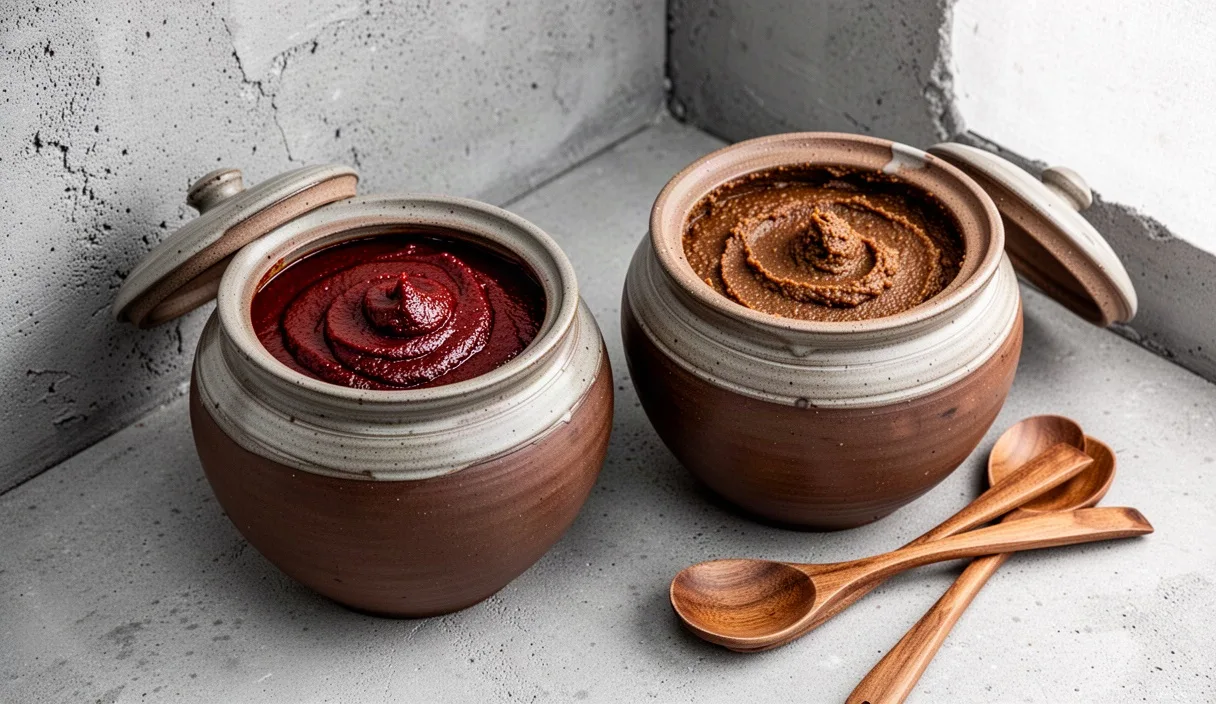
Choose the right paste immediately. Grab the red plastic tub for gochujang when you need concentrated heat, ferment-driven sweetness, and a thick glaze that coats pork, chicken, and rice cakes. Reach for the brown tub for doenjang when you need deep, savory salinity, earthy funk, and a mineral-rich backbone for broths, vegetable marinades, and dipping pastes.
Both pastes trace back centuries in Korean culinary history, yet they behave completely differently in a hot pan or a simmering clay pot. Confusing one for the other ruins the balance of your dish because their sugar content, salt saturation, and textural bases share little in common. Understanding what happens inside the earthenware crock during production gives you total control over how these staples react to heat, moisture, and time.
Fermentation bases and production differences
Every traditional batch of doenjang begins with dried yellow soybeans. Producers boil the beans in water until soft, crush them into a coarse mash, and shape them into dense rectangular blocks called meju. Workers hang these blocks using dried rice straw under eaves to dry. Wild bacteria, primarily Bacillus subtilis, alongside natural molds, penetrate the blocks from the air and the straw. Once dried and inoculated, meju blocks submerge into large glazed clay onggi jars filled with a 17 to 20 percent brine solution. They sit in the sun for 40 to 60 days. The liquid drawn off becomes guk-ganjang (soup soy sauce). The remaining softened soybean solids are mashed with coarse solar salt and packed back into onggi to age for anywhere from six months to several years. The result is an intensely savory, chunky, umami-dense paste with zero added sugars.
Gochujang requires an entirely different biochemical starting point. While meju forms the protein backbone, it accounts for only a fraction of the total volume. The primary bulk comes from sweet glutinous rice (chapssal), barley malt powder (yeotgireum), fine sun-dried red chili pepper powder (gochugaru), and salt. The malt enzymes break the starches of the cooked rice down into fermentable simple sugars, mostly maltose and glucose, through active saccharification. Fine meju powder and red chili powder are stirred directly into this sweet porridge along with sea salt. The blend ferments in outdoor jars for six months or longer. As the paste matures, the sweetness from the malted starches melds with the capsaisin from the peppers and the amino acids from the meju, producing a smooth, glossy, crimson paste.
Industrial commercial manufacturing introduces shortcuts that split supermarket tubs further away from traditional artisanal preparations. Factory producers often replace meju blocks with defatted soybean flakes treated with hydrochloric acid or steam-injected starters. For mass-market gochujang, industrial processors frequently substitute high-fructose corn syrup, wheat flour, and rice syrup for barley-malted glutinous rice to cut costs and speed production turnover. Check the ingredient label: an authentic gochujang lists glutinous rice and fermented soybean powder near the top, while an inferior commercial tub lists wheat flour and corn syrup as the primary bulk agents.
| Factor | Gochujang (Red Tub) | Doenjang (Brown Tub) |
|---|---|---|
| Primary Base | Glutinous rice, malted barley, meju powder | Whole fermented soybeans, brine, sea salt |
| Flavor Profile | Sweet, spicy, pungent, acidic undertones | Nutty, earthy, deeply salty, savory umami |
| Texture | Smooth, sticky, dense, uniform paste | Chunky, grainy, coarse, paste-like mash |
| Dominant Microbes | Aspergillus oryzae, wild yeasts | Bacillus subtilis, wild ambient molds |
| Standard Ferment Time | 6 to 12 months | 6 months to 3 years |
Sodium levels across common commercial brands
Never salt a Korean dish before measuring your paste. Sodium levels vary wildly between styles and brands, and doenjang consistently delivers far more salt per gram than gochujang. Doenjang relies on high salt concentrations to suppress spoilage during the long soybean fermentation without sugar protection. Gochujang relies partly on its heavy sugar concentration and natural pepper capsaisin for preservation, meaning it requires less raw sodium chloride by volume to stay stable.
A single tablespoon of commercial doenjang (roughly 15 to 18 grams) typically contains between 480 milligrams and 620 milligrams of sodium. That represents roughly 21 to 27 percent of the daily recommended sodium allowance in a single spoonful. In contrast, a 15-gram tablespoon of commercial gochujang averages between 380 milligrams and 490 milligrams of sodium. The lower sodium reading in gochujang fools many home cooks into adding extra salt, ignoring the fact that gochujang contains roughly 8 to 11 grams of carbohydrates per tablespoon, mostly in fast-absorbing sugars.
| Brand and Product | Serving Size | Sodium Content | Total Sugars |
|---|---|---|---|
| CJ Haechandle Traditional Doenjang | 15 g (1 tbsp) | 580 mg | 1 g |
| Sempio Fermented Soybean Paste (Doenjang) | 15 g (1 tbsp) | 610 mg | 1 g |
| Daesang O'Food Soybean Paste | 15 g (1 tbsp) | 520 mg | 2 g |
| CJ Haechandle Hot Pepper Paste (Gochujang) | 15 g (1 tbsp) | 410 mg | 8 g |
| Sempio Sun-Dried Red Chili Paste (Gochujang) | 15 g (1 tbsp) | 460 mg | 9 g |
| Daesang O'Food Medium Hot Gochujang | 15 g (1 tbsp) | 390 mg | 7 g |
Anyone managing blood pressure, cardiovascular conditions, or chronic kidney concerns should treat these numbers seriously. Adjust your recipes accordingly: if a recipe calls for two tablespoons of doenjang, do not season your broth with regular table salt, kosher salt, or standard soy sauce until the stew has simmered completely and you have tasted the finished baseline. If medical dietary limits apply to your household, consult a licensed clinical dietitian before introducing unpasteurized or high-sodium fermented pastes into your weekly meal planning.
Best applications for soups and stews
Stews (jjigae) and soups (guk) reveal the structural divide between these two ingredients. Doenjang-jjigae stands as Korea's daily table standard. The coarse soybean fragments in doenjang dissolve into broth to form an emulsion, lending body and a rounded mouthfeel without needing butter, flour, or starch slurries. Gochujang-jjigae, while popular, yields a heavier, sweeter broth that clings tightly to ingredients like fatty pork ribs, zucchini, and waxy potatoes.
To build a standard doenjang-jjigae, start with an assertive broth. Simmer six to eight dried anchovies (gutted) and one square sheet of dashima (dried kelp) in 800 milliliters of cold water for 15 minutes, then discard the solids. Take two and a half tablespoons of doenjang and press it through a small wire strainer mesh directly into the simmering broth with the back of a spoon. Catching the fibrous soy skins in the sieve allows you to grind them finely into the liquid or discard them entirely if you prefer a silky restaurant-style broth. Add cubed firm tofu, sliced zucchini, shiitake mushrooms, and sliced radish. Simmer on medium heat for 12 minutes. Finish with chopped scallions and hot green chilies during the final two minutes.
Gochujang-jjigae requires the opposite handling. Dissolve two tablespoons of gochujang alongside one teaspoon of doenjang directly into 700 milliliters of anchovy or light pork stock. The small addition of doenjang cuts the sweet cloying tendency of the gochujang and introduces balancing savory depth. Gochujang does not contain soybean husks, so it dissolves cleanly into hot stock without a sieve. Drop in cut pork belly pieces, cubed potatoes, and yellow onions. Simmer for 18 to 22 minutes until the starches from the potatoes release into the liquid, uniting with the glutinous rice base of the gochujang to create a rich, spicy gravy.
For dipping applications, mix the two together to create classic ssamjang for Korean barbecue. Combine these measured ingredients in a bowl:
- Three tablespoons of commercial or house doenjang
- One tablespoon of gochujang
- One clove of garlic, minced into a fine paste
- One green scallion, finely diced
- One teaspoon of raw honey or brown rice syrup
- Two teaspoons of toasted dark sesame oil
- One teaspoon of toasted whole sesame seeds
Stir vigorously until the oil integrates. The dominant doenjang provides body and salt, while the minor measure of gochujang contributes heat and shine without overwhelming delicate leaves of red leaf lettuce, perilla leaves, or grilled pork slices.
Marinade formulations and burner scorch risks
Cooking with gochujang over direct high heat is dangerous for inexperienced line cooks. The concentrated simple sugars, rice starches, and corn syrups in commercial gochujang char quickly. Maltose and fructose begin to caramelize around 160 degrees Celsius (320 degrees Fahrenheit) and burn black past 175 degrees Celsius (350 degrees Fahrenheit). Capsaicin-heavy powders like gochugaru release acrid, irritating airborne smoke the instant they scorch, destroying the flavor of meat and filling your kitchen with choking fumes.
When cooking spicy pork bulgogi (jeyuk bokkeum) coated in a gochujang marinade, control the surface heat strictly. Mix two tablespoons of gochujang with one tablespoon of light soy sauce, one tablespoon of mirin, one tablespoon of minced garlic, one teaspoon of minced ginger, and one tablespoon of grated yellow onion. The water content from the grated onion and mirin helps delay burning. Sear the meat in a heavy cast-iron skillet over medium-low heat rather than high heat. Keep the meat moving continuously with tongs. Do not place gochujang-marinated meats directly over open charcoal flames unless you maintain an indirect two-zone grill setup, resting the meat on the cool side of the grate while the marinade sets.
Doenjang presents virtually no scorch hazard compared to chili paste. Because standard doenjang contains almost no free simple sugars (averaging one to two grams of total carbohydrates per serving), it behaves like white or yellow miso. You can use doenjang to marinate thick cuts of pork shoulder, chicken thighs, or oily fish like mackerel and sablefish without fast pan-scorching. Blend three tablespoons of doenjang with two tablespoons of rice wine (cheongju or sake), one teaspoon of sesame oil, and a half-teaspoon of black pepper. Slather onto meat and let it rest in the refrigerator for four to twelve hours.
The intense salt in a doenjang marinade functions as an exterior brine. Over twelve hours, the sodium denatures meat surface proteins, pulling moisture out initially before reabsorbing seasoned liquid back into the core fibers. When cooking doenjang-marinated proteins, wipe off excessive surface chunks using a dry paper towel before dropping the meat onto a medium-hot cast-iron pan. The residual paste browns into an attractive, deeply savory crust without turning into the acrid, bitter black char that comes from burned sugar.
Cold storage longevity checklist
Both gochujang and doenjang are shelf-stable products when sealed in original factory packaging, but their preservation clock starts the moment you pull back the inner foil seal. Ambient air introduces mold spores, oxygen dries out the edges of the paste, and warm temperatures degrade delicate aroma molecules over weeks of storage. Maintain quality with this refrigeration checklist:
- Keep the temperature under 4 degrees Celsius (39 degrees Fahrenheit): Place both tubs inside the main body of your refrigerator. Never store open tubs in the refrigerator door shelves, where constant opening causes the temperature to fluctuate between 5 and 9 degrees Celsius.
- Eliminate open airspace inside the tub: Oxygen causes the top layer of gochujang to darken from bright crimson to a dull blackish-brown due to oxidation. After scooping your portion, use the back of a clean spoon to smooth the remaining paste completely flat across the tub.
- Apply a surface barrier: Cut a small square of plastic cling wrap or parchment paper and press it directly against the flattened surface of the paste, tucking the edges down against the inner walls of the plastic tub before snapping the lid closed.
- Practice strict utensil sanitation: Never use a wet spoon, a finger, or a spoon previously licked or dipped in broth to remove paste from the tub. Moisture introduction and cross-contamination from cooking broths are the primary reasons molds grow inside high-salt fermented pastes.
- Recognize normal crusting versus contamination: White crystals forming on the surface of long-aged doenjang are usually tyrosine crystals, a harmless by-product of broken-down proteins, safe to consume. White, green, black, or fuzzy mold spreading along the plastic walls indicates external fungal contamination: discard the tub immediately.
- Track consumption timelines: High-salt commercial doenjang keeps in prime condition for 18 to 24 months in a steady cold refrigerator. Commercial gochujang retains optimal flavor for 12 to 18 months; beyond that point, it loses bright spicy punch and hardens into a dense, gummy paste.
Common mistakes
The most frequent error is substituting doenjang directly for Japanese miso at a one-to-one ratio. Japanese white (shiro) or yellow (shinshu) miso is fermented with grains like rice or barley alongside soybeans, producing a delicate, mild, slightly sweet profile. Doenjang contains almost entirely soybeans, yielding a significantly saltier, funkier, and sharper profile. If an American or European recipe calls for two tablespoons of light miso, using two tablespoons of doenjang will overwhelm the soup with salt and pungent earthiness. Start with one-third the amount of doenjang and add warm water or unseasoned stock to balance the potency.
A second common mistake involves boiling doenjang for excessive periods. Simmering doenjang for longer than 25 minutes destroys its volatile aromatic compounds, dulling the bright fermented funk into a flat, harsh salt base. Boil hard aromatics like potatoes, onions, and beef brisket in your stock first. Add the doenjang during the final ten to twelve minutes of total cooking time to protect its flavor profile.
Finally, avoid dumping gochujang directly into cold liquids or dry stir-fries without thinning it first. Because commercial gochujang is dense, sticky, and starchy, dropping a solid dollop into a cold pan leaves you with uneven, charred globs stuck to the pan bottom alongside unseasoned vegetables. Always thin your gochujang in a small prep bowl with a splash of warm water, soy sauce, cooking wine, or broth before pouring it over your ingredients.
Next steps for your pantry
Open your refrigerator right now and inspect your tubs. Check the date markers on your containers and verify that the foil films have been replaced with clean parchment or plastic wrap pressed tightly against the paste surface. If your gochujang has separated into a liquid film over a rock-hard maroon brick, toss it and purchase a fresh container featuring glutinous rice instead of wheat flour.
Stock your working spice drawer with whole dried anchovies, dashima kelp sheets, and coarse Korean solar salt. With those three items paired with proper tubs of doenjang and gochujang, you can execute authentic Korean bases, stews, glazes, and dipping sauces on fifteen minutes notice without relying on pre-mixed commercial seasoning packets.