 FlavorAtlas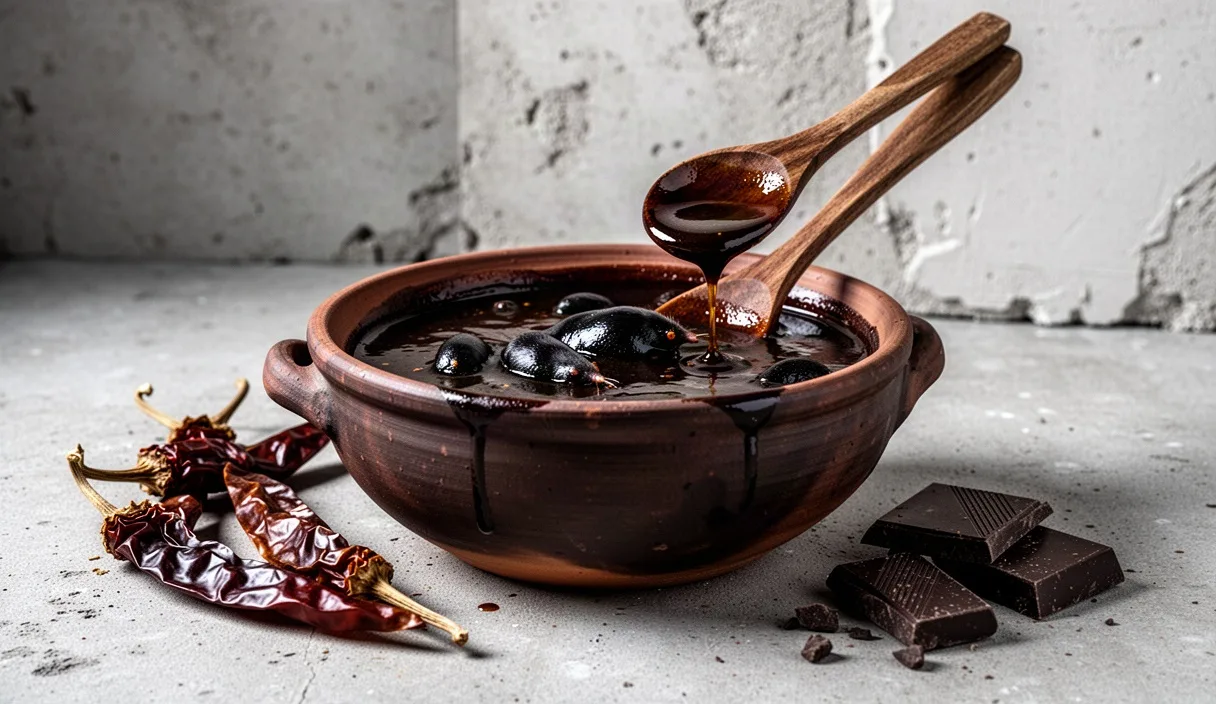
Mole negro demands precise technique. It is not an everyday sauce, and it cannot be rushed in an afternoon. Authentic preparation in Oaxaca spans two full days, balancing dozens of ingredients through distinct cooking methods: dry roasting, deep frying, charring, water-leaching, fine milling, and hours of stovetop reduction. The goal is not sweetness, nor is it raw heat. True mole negro delivers savory depth, mild bitterness, controlled acidity, and a deep umami finish derived from slow-cooked seeds and chiles.
Home kitchens present unique challenges for this dish. Domestic stoves produce uneven hot spots, residential range hoods struggle with smoke from charred seeds, and standard blenders leave gritty textures if rushed. To succeed at home, you must break the process into organized stages. Prepare your stock ahead of time, measure ingredients by weight rather than volume, and follow the exact mechanics of fat frying and seed carbonization explained below.
The four essential Oaxacan chiles
Balance four specific dried chiles to build the traditional base. The foundational chile is the chilhuacle negro, an endemic Oaxacan variety with matte, dark-gray skin, thin walls, and notes of dry tobacco and cocoa. Authentic chilhuacle negro chiles are expensive and scarce outside Mexico. If you cannot source them from an importer, use a calculated blend of mulato and extra pasilla mexicano to mimic the profile. Do not substitute ancho chiles alone; anchos carry too much residual sugar and fruitiness for the dark Oaxacan profile.
Mulato chiles provide the body and sweet-licorice undertones. Pasilla Oaxaqueño delivers woodsmoke and heat, though standard pasilla mexicano works if smoked chipotle meco is added for woodsmoke notes. Guajillo contributes sharp acidity and bright red color that keeps the mole from tasting muddy or flat before the blackened seeds turn the sauce dark.
| Chile Variety | Grams per Batch | Primary Flavor Profile | Preparation Method |
|---|---|---|---|
| Chilhuacle Negro | 150g | Bitter cocoa, dry tobacco, mild heat | Wiped clean, stemmed, seeded, lightly toasted |
| Mulato | 250g | Licorice, dried cherry, chocolate | Wiped clean, stemmed, seeded, fried in lard |
| Pasilla Oaxaqueño | 120g | Smoke, prune, medium heat | Wiped clean, stemmed, seeded, lightly toasted |
| Guajillo | 100g | Sharp acid, green tea, bright fruit | Wiped clean, stemmed, seeded, fried in lard |
Stem every chile carefully. Slit them open lengthwise and shake out every seed and interior vein into a stainless steel bowl. Do not discard these seeds. You will use them in the next stage to create the primary pigment and bitter foundation of the mole.
Seed charring technique
Carbonizing seeds provides the color. Mole negro does not get its midnight shade from chocolate. It gets its color from controlled carbon produced by burning the reserved chile seeds and placenta veins. Burn only the seeds; never burn the chile skins. Burnt chile flesh produces an acrid, sour flavor that ruins the batch. Burnt seeds, once washed, produce pure black pigment and an aromatic, savory bitterness.
Set a heavy cast iron comal or skillet over high heat. Turn your kitchen exhaust fan to its highest setting and open adjacent windows. Work in small batches of roughly 75 grams. Dump the chile seeds onto the hot dry pan. Stir constantly with a metal spatula. The seeds will crackle, smoke heavily, turn golden, then brown, and finally catch flame or turn into jet-black carbon within 4 to 6 minutes.
Extinguish the flames by stirring vigorously, or cover the pan with a lid if flare-ups grow too high. Once the seeds are uniformly blackened all the way through, immediately dump them into a bowl of cold tap water. The water will hiss and turn black instantly.
Rinse the seeds to remove harsh surface ash. Leave the charred seeds in the water for 25 minutes, then drain them through a fine-mesh wire sieve. Refill the bowl with fresh cold water, stir, and soak for another 20 minutes. Drain again. This double-soak removes volatile acridity while leaving the carbon structure intact. Set the soaked, charred seeds aside to be pureed with the aromatics.
Fried fruit and nut binders
Fry each secondary ingredient separately in fresh pork lard. Different binders burn at different temperatures, so you cannot combine them in the pan. Heat 200 grams of pure leaf lard in a wide Dutch oven over medium heat. Keep your flame adjusted between 160 and 180 degrees Celsius. As ingredients brown, transfer them with a slotted spoon to a large rimmed tray to cool.
- Plátano macho (ripe plantain): 1 medium plantain, peeled and sliced into 1-centimeter rounds. Fry for roughly 4 minutes until deeply caramelized and dark brown around the edges. This starch thickens the sauce and adds sweetness to counteract seed bitterness.
- Dried fruits: 80 grams of dark raisins. Drop into the lard for 45 to 60 seconds. Remove immediately once they puff into spheres.
- Nuts and seeds: 75 grams of raw shelled peanuts, 75 grams of raw almonds, and 60 grams of raw pumpkin seeds (pepitas). Fry each variety separately until fragrant and pale gold. Fry 100 grams of white sesame seeds last in a dry pan or lightly oiled skillet until toasted, saving 20 grams raw for garnish later.
- Starch thickeners: 1 dry corn tortilla and 1 slice of stale crusty white bread (bolillo or pan de yema). Fry the bread until golden brown. Char the tortilla over an open flame until completely blackened on both sides, then soak in water with the seeds.
- Aromatics and spices: 1 large white onion (quartered), 8 peeled garlic cloves, 3 whole cloves, 4 allspice berries, 1 piece of Mexican canela (Ceylon cinnamon, 5 centimeters long), 2 grams of dried Mexican oregano, and 2 grams of dried thyme. Fry the onions and garlic in lard until blistered and soft. Toast the whole spices in a dry skillet for 90 seconds until fragrant.
- Chocolate: 120 grams of Mexican table chocolate, chopped into shards. Set aside; do not fry.
Retain the remaining rendered lard in the pan. You will use it later to sear the blended paste.
Blending order and texture control
Mill the ingredients into an ultra-smooth paste. Traditional Oaxacan cooks use a stone metate or take their ingredients to a neighborhood molino (commercial wet mill). A standard home food processor will not work here. You must use a high-powered blender running at maximum speed for sustained periods to break down the fibrous chile skins and carbonized seeds.
Work in three distinct batches to avoid overloading the blender motor and to guarantee thorough processing:
- Batch one (The Black Puree): Combine the drained charred seeds, the charred tortilla, the fried onions, garlic, whole spices, herbs, and 300 milliliters of rich poultry stock. Blend on high for 3 full minutes. Stop to push down the sides. The mixture must resemble slick black paint with zero visible grit.
- Batch two (The Chiles): Place the soaked, fried chile skins into the blender jar with 400 milliliters of warm stock. Puree on high speed for 3 to 4 minutes until thick, maroon-red, and uniform.
- Batch three (The Binders): Blend the fried plantain, raisins, almonds, peanuts, pepitas, toasted sesame seeds, fried bread, and 300 milliliters of warm stock for 2 minutes until smooth and nutty brown.
Strain batches one and two through a fine-mesh chinois or wire strainer into large bowls. Use a ladle or flexible silicone spatula to push the paste through the mesh. Discard any tough skins or seed fragments caught in the wire. Batch three (the nut and fruit paste) does not require straining if your blender is sufficiently powerful. Combine all three pastes together in a large prep bowl and stir until thoroughly integrated.
Slow reduction on domestic burners
Sear the paste to activate the fat. Heat 4 tablespoons of fresh lard in a heavy-bottomed 8-quart enameled Dutch oven over medium-high heat until the lard ripples. Pour the entire combined paste into the hot lard all at once. The paste will spatter violently. This step, known locally as chillar la cazuela (making the pot scream), fries the blended chiles and binds the fat into the sauce base.
Fry the paste over medium heat for 20 minutes, stirring constantly with a flat wooden spoon. Ensure the spoon scrapes the bottom corners of the pot to prevent scorching. The paste will darken visibly from reddish-brown to dark chocolate black as moisture evaporates and the sugars caramelize against the hot oil.
Add warm, rich turkey or chicken stock to thin the sauce. Pour in 1.5 liters of stock in three additions, stirring thoroughly after each pour until the liquid is fully incorporated. Add the chopped Mexican chocolate and 2 teaspoons of coarse sea salt. Lower the flame to the absolute minimum setting.
Use a cast iron heat diffuser plate beneath your pot if you cook on a domestic gas range. Domestic burners concentrate intense heat in a small ring, which burns dense mole pastes quickly. Simmer the mole uncovered for 2.5 to 3.5 hours. Stir every 8 to 10 minutes, always scraping the bottom.
The mole is finished when a glossy sheen of oil floats to the surface and separates along the edges of the pot. Taste for balance. It should register initial savory bitterness, deep chile fruitiness, a gentle hum of canela, and subtle smoke. If it tastes excessively bitter, stir in 1 teaspoon of piloncillo or brown sugar. If it tastes heavy or greasy, add 100 milliliters of unsalted stock and simmer for another 15 minutes.
Common mistakes
Avoid these four critical errors during preparation:
- Burning the chile pods: If your dried chiles turn black while frying, throw them out. Burnt skins create an acrid flavor that sugar cannot fix. Only the separated seeds should be turned black.
- Skipping the seed soak: Dropping raw charred seeds straight into the blender traps unwashed ash in the mole, producing a caustic, gritty sauce. The double water rinse is mandatory.
- Using commercial chicken bouillon: Mole negro reduces by roughly 30 percent during cooking. Commercial bouillons contain high concentrations of sodium and industrial flavorings that concentrate into an overwhelmingly salty sauce. Use homemade unsalted poultry stock.
- Serving immediately: Freshly cooked mole tastes fractured. The spices, chiles, and fat require 12 to 24 hours of rest in the refrigerator to harmonize. Cook the mole at least one full day before you plan to serve it.
Next steps
Source your dried chiles first. Find a reliable Latin market or specialty Oaxacan importer to acquire proper mulato, guajillo, and pasilla varieties. Plan your cooking across a weekend. Dedicate the first day to roasting, charring, frying, and blending all components. Chill the paste overnight in the refrigerator. On the second day, sear the paste in hot lard, add your stock, and complete the long reduction on the stovetop. Cool the finished mole completely, refrigerate it overnight once more, and reheat gently over low heat to serve over poached chicken, braised turkey, or warm corn tortillas.