 FlavorAtlas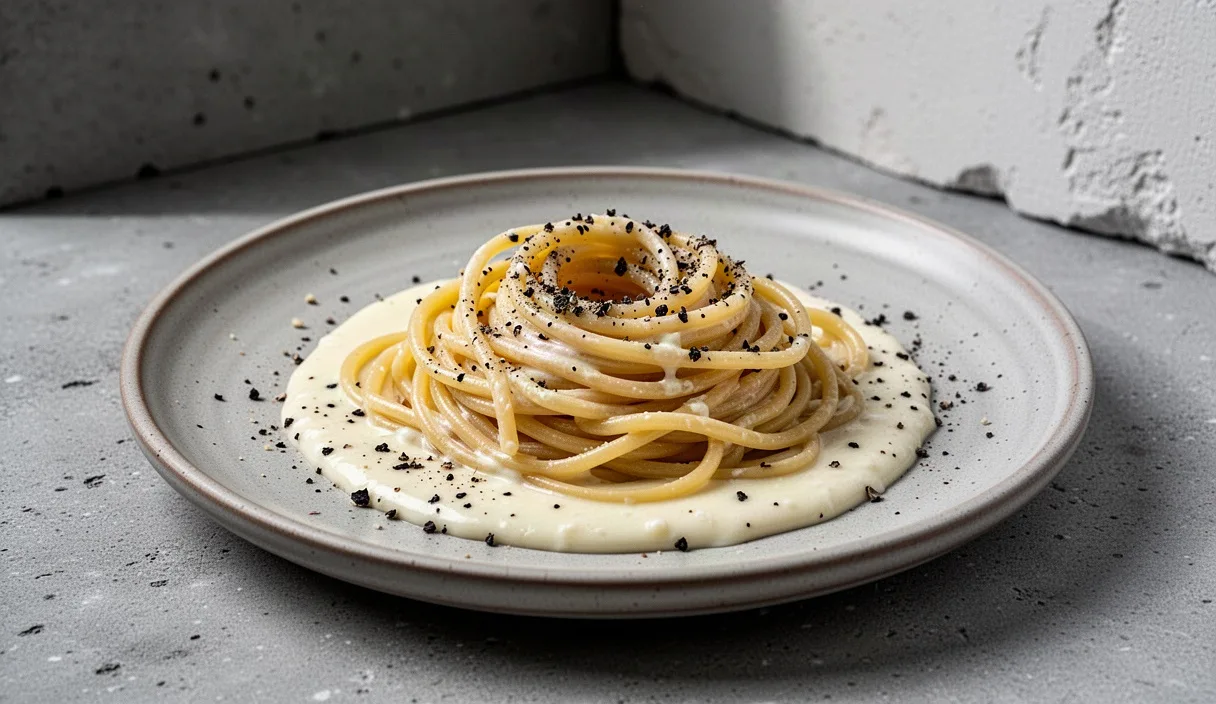
Cacio e pepe demands precise chemistry. The sauce consists of three items: dried durum wheat pasta, sheep milk cheese, and cracked black pepper. There is no cream, butter, olive oil, or pasta cooking water added indiscriminately at boiling temperatures. The technique relies entirely on balancing cheese protein coagulation points against starch gelatinization to form a smooth suspension instead of stringy curds floating in oily liquid.
Cooking this dish successfully requires strict temperature control, mechanical agitation, and water volume management. Understanding what happens at the molecular level turns an unpredictable dish into a repeatable kitchen process. If the cooking water is too hot, proteins bond into a dense clump. If the water lacks dissolved starch, oil and water separate. Every parameter below outlines the exact thresholds needed for a stable emulsion.
Cheese selection: Pecorino Romano DOP versus blends
Pecorino Romano DOP is non-negotiable for traditional Roman flavor, yet its physical properties make it challenging to melt. Produced in Lazio, Sardinia, and parts of Tuscany from whole sheep milk, this cheese ages between 8 and 12 months for table use, or up to 14 months for grating. It features a moisture content below 32 percent and a fat content of roughly 36 percent in dry matter. The high salt profile, usually 4 to 5 percent by weight, affects how protein networks break down under heat.
Grating geometry determines how fast the cheese dissolves. Run the cheese block against the smallest microplane holes or an ultra-fine rotary drum to produce airy, powdery strands that resemble fresh snow. Thick shavings or coarse shreds from a box grater take twice as long to melt, absorbing heat unevenly and coagulating before they can disperse into the cooking liquid.
| Cheese Type | Aging Period | Moisture Level | Emulsion Behavior |
|---|---|---|---|
| Pecorino Romano DOP | 8 to 12 months | 30 to 32 percent | Sharp, pungent; curds tighten rapidly past 149 degrees F. |
| Pecorino Sardo Dolce | 1 to 2 months | 38 to 43 percent | Melts easily; mild flavor; lower salt content. |
| Grana Padano | 12 to 16 months | 32 to 34 percent | Stable melt; cow milk base; lacks characteristic sheep pungency. |
| Pecorino/Parmigiano Blend (70/30) | 12 to 24 months | 29 to 32 percent | Tolerates heat slightly better; softens the aggressive salt bite. |
Blends of 70 percent Pecorino Romano and 30 percent Parmigiano-Reggiano aged 24 months are common in modern Roman restaurants. Parmigiano-Reggiano introduces free amino acids (glutamates) and a slightly lower mineral salt concentration, which broadens the temperature window before clumping occurs. Purists stick to single-origin Pecorino Romano, but home cooks facing burner heat spikes can use this 70/30 ratio to build a protective buffer against graininess.
Black pepper toasting temperatures
Pepper provides aromatic complexity through piperine and volatile essential oils, mainly pinene, sabinene, and limonene. Piperine produces heat on the tongue, while the volatile terpenes yield citrus, wood, and floral aromas. Whole black peppercorns from Tellicherry or Malabar origins offer distinct oil densities; select berries with high surface wrinkling and solid heft.
Grind size must be heterogeneous. Do not use an electric spice blade that yields uniform dust. Crush whole peppercorns in a heavy cast-iron mortar and pestle or set a burr grinder to a coarse crack. You need fine particles to season the water and large cracked fragments to provide textural crunch throughout the pasta coils.
- Pan Surface Temperature: Target 265 to 300 degrees F in a dry, heavy skillet over medium-low heat.
- Toasting Duration: 60 to 90 seconds maximum. Swirl constantly.
- Visual Cue: The pepper surfaces will develop an oily sheen as internal lipids migrate outward.
- Sensory Cue: A pungent, nutty, woody aroma rises from the pan. If you see white smoke, the piperine has burned, creating acrid bitterness; discard the batch and wipe the skillet clean.
- Blooming Action: Add two ladles of warm, starchy pasta water directly to the toasted pepper. The pan will hiss violently, quenching the heat and pulling the fat-soluble flavor compounds directly into the liquid base.
Boiling the pepper in water after dry-toasting softens the physical cracked pieces, preventing them from feeling like gravel against your teeth. Simmer the pepper liquid for 2 minutes while the pasta finishes cooking in the adjacent pot.
Starch concentration in low-water boiling
Traditional culinary rules dictate cooking 450 grams of pasta in 4 to 5 liters of boiling water. For cacio e pepe, invert this principle. Use only 1.5 to 2 liters of water for the same volume of pasta. A smaller water volume concentrates the amylose and amylopectin starches washed off the pasta surfaces into a thick, cloudy suspension.
Starch acts as a natural surfactant and physical stabilizer. In an emulsion, fat droplets naturally want to coalesce and separate from water molecules. Amylose molecules suspend themselves between the fat droplets shed by the Pecorino and the aqueous pasta cooking liquid, physically blocking the fat droplets from fusing back into an oily slick.
- Select the Pasta: Choose rough-surfaced, bronze-die extruded spaghetti, tonnarelli, or bucatini. The chalky white exterior indicates loose surface starches that release directly into the pot. Smooth, teflon-die pasta yields far less functional starch.
- Measure the Salt: Cut standard salting practices in half. Add only 5 to 7 grams of salt per liter of water. Because Pecorino Romano contains roughly 4.5 percent salt, normal pasta water will make the finished reduction unpalatably salty.
- Stir Continuously: During the first 4 minutes of cooking in low water, stir the noodles constantly using tongs. This frees excess surface starches into the liquid and keeps long strands from sticking to the pot bottom.
- Pull Underdone: Remove the pasta from the water 3 minutes ahead of the package al dente mark. Transfer it directly to the pepper pan so the noodles finish cooking while actively absorbing the pepper infusion and coating themselves in concentrated starch water.
Off-heat pan emulsion mechanics
The primary reason cacio e pepe fails is heat. Sheep milk proteins, specifically caseins, destabilize and shrink tightly when heated beyond 145 to 150 degrees F. When caseins contract, they squeeze out moisture and fat, tangling together into hard, rubbery curds. The goal is to bring the cheese to its melting point (roughly 125 to 135 degrees F) without crossing the curdling threshold.
Never add dry grated cheese directly into a hot skillet resting on an active burner. Build a paste beforehand or lower the thermal mass of the system entirely.
The Paste Method
In a ceramic or stainless mixing bowl, combine 120 grams of microplaned Pecorino Romano with 60 to 75 milliliters of warm, starchy pasta water. The water temperature must sit between 130 and 140 degrees F. Whisk vigorously using a small balloon whisk or fork. The starch and water will hydrate the dry proteins, forming a thick, smooth, spreadable paste with no dry pockets. If it looks dry, add more water half a tablespoon at a time.
The Pan Integration
Transfer the pasta, cooked to firm al dente, directly into the pepper skillet. Toss the noodles vigorously over medium heat for 60 seconds with a ladle of extra starch water to develop a thin, glossy glaze across each strand. Then execute these critical steps:
- Remove Pan From Heat: Set the skillet onto a cool work surface or wooden cutting board.
- Cool the System: Lift and drop the pasta continuously with tongs for 30 to 45 seconds. Watch the steam clouds thin out. Use an infrared thermometer to confirm the pan surface and noodles have dropped to 138 degrees F.
- Introduce the Paste: Scrape the Pecorino paste over the warm pasta.
- Agitate Mechanically: Toss and swirl immediately. Rapid circular movement forces the liquid fat droplets to break down into micro-droplets, suspended evenly within the gelatinized starch liquid. Continue tossing until a glossy, creamy sauce coats every noodle and leaves no puddles at the pan edges.
Fixing split sauces quickly
If the sauce splits into a pool of yellow fat and a clump of rubbery cheese, the emulsion has collapsed. Heat shock or inadequate agitation is usually the cause. You can recover the sauce if you act before the cheese curds cool completely and harden into hard plastic-like ropes.
Assess the pan condition immediately. If you see clear oil floating on top of thin liquid, the temperature was too high or the starch ratio too low. If you see a solitary gummy ball adhering to the tongs, the cheese hit dry heat without pre-hydration.
- Drop the Temperature Instantly: Pour 30 milliliters (two tablespoons) of cold tap water directly down the side of the pan. Cold water shocks the exterior of the hot fat droplets, drops the overall skillet temperature below the coagulation point, and restores liquid volume.
- Agitate Off-Heat: Remove the skillet entirely from the stove area. Using tongs in one hand and shaking the skillet with the other, whip the noodles vigorously against the pan wall. The shear force helps force the separated fat back into the starch-water phase.
- The Immersion Blender Technique: If the sauce has curdled into small grains that refuse to blend by hand, transfer the noodles temporarily to a warm bowl. Scrape the remaining watery liquid and cheese curds into a tall blending cup. Add one tablespoon of warm, high-starch pasta water and blend on high speed for 10 seconds. The mechanical blades tear the coagulated protein clusters apart, re-emulsifying the fat and liquid instantly. Pour the reconstituted sauce back over the warm noodles and toss once.
- Starch Water Boost: If the mixture looks oily but not yet curdy, ladle in 20 milliliters of hot water taken from the pasta pot, provided it looks opaque and cloudy. Whisk aggressively for 15 seconds to let fresh amylose trap the free-floating fats.
Common mistakes
Avoid these specific procedural errors to protect the emulsion integrity:
- Using Pre-Grated Cheese: Packaged grated cheese contains anti-caking agents such as cellulose or potato starch powder. These desiccants absorb liquid unpredictably and prevent cheese proteins from forming a continuous matrix, resulting in a gritty, sandy texture.
- Leaving the Pan on an Active Induction or Gas Eye: Even with the flame turned off, heavy cast iron or tri-ply stainless cookware holds thermal energy. Always slide the skillet completely off the burner eye before folding in the cheese paste.
- Over-salting the Pasta Water: Concentrating water down through low-volume boiling naturally magnifies salt levels. Adding standard salt quantities produces an inedible finished plate once the reduced water binds with the salty Pecorino.
- Waiting Too Long to Serve: Cacio e pepe has a short stability window. Within 4 to 6 minutes of plating, as temperature drops below 115 degrees F, the starches firm up and the fats begin to solidify, causing the sauce to lose its sheen and turn paste-like.
Next steps for consistent execution
Consistency requires eliminating guesswork from your variables. Acquire an infrared surface thermometer to track your pan temperatures until you can identify the correct heat levels by steam volume alone. Practice grating a standard 200-gram wedge of Pecorino Romano using a rasp grater to establish the exact visual baseline for weight versus volume.
For your next session, weigh your pasta and water precisely: use 250 grams of bronze-cut tonnarelli or spaghetti in 1 liter of water with exactly 5 grams of salt. Time your pull at 8 minutes, leaving two minutes of carryover cooking inside the pepper reduction. Keep your whisk and mixing bowl next to the range so you do not lose precious seconds when assembling the paste. Master the baseline mechanics first before experimenting with pepper varieties or cheese blending ratios.