 FlavorAtlas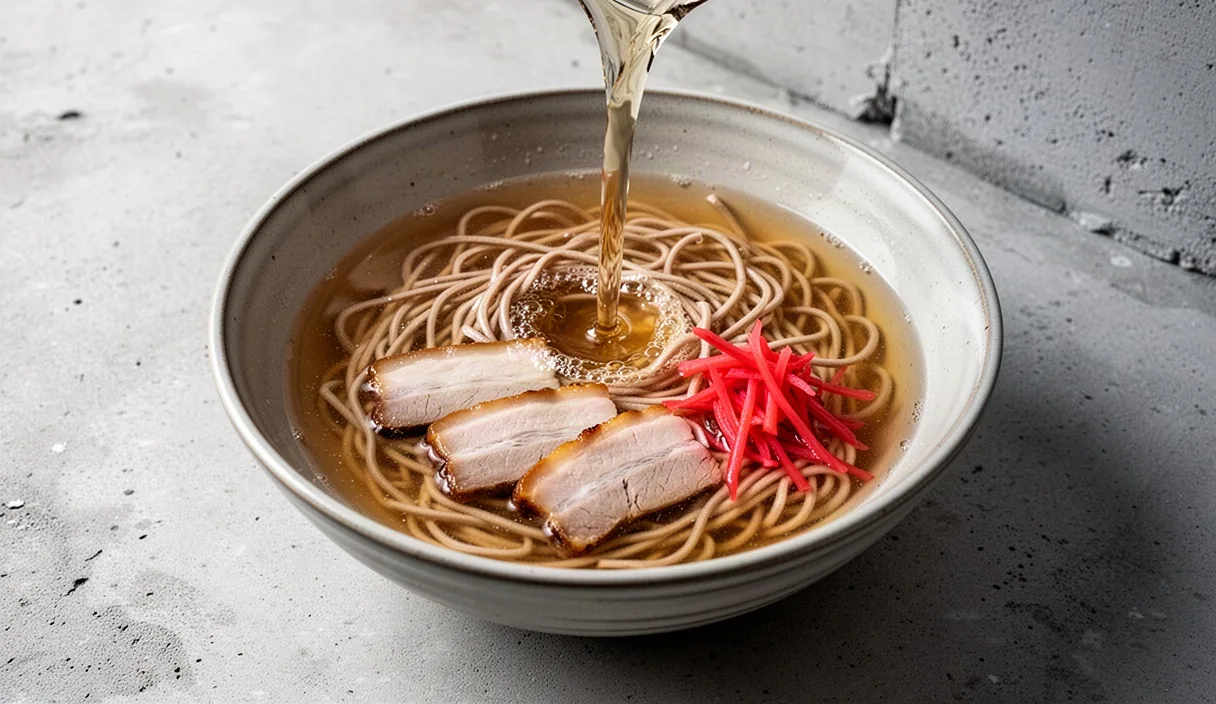
Okinawan soba broth lives or dies by its balance between rich pork marrow and sharp, smoky bonito dashi. Unlike mainland tonkotsu, which relies on a heavy, emulsified boil that turns opaque and milky, traditional Ryukyuan broth remains clear, golden, and light on the palate. Achieving this requires managing two separate extractions: a long, sub-boil simmer of cleaned pork bones and a fast, high-temperature steep of thick-shaved dried skipjack tuna flakes (katsuo kezuribushi). Getting the balance wrong yields either a greasy soup that overpowers the wheat noodles or a thin broth that tastes like diluted noodle water.
The standard benchmark across modern Okinawa rests between a 60:40 and a 70:30 volume ratio of pork broth to katsuo dashi. Some northern regions around Yanbaru push the pork higher toward an 80:20 ratio for a heavier bowl, while southern Naha styles often favor a lighter 55:45 split. Whatever profile you choose, you cannot build both components in a single pot. You must draw the collagen and marrow cleanly from the bones, brew an intense dashi separately, marry them, and finish with cooked-out awamori and sea salt. Here is how to execute every stage with precision.
Bone selection and pre-boil purge
Pork femur bones, known as genkotsu, provide the structural gelatin and clean marrow necessary for body. Do not rely entirely on femurs, however. A pure femur broth lacks savory meatiness. Combine femur bones with pork spine (sebone) or neck bones in an approximate 3:2 ratio by weight. Neck and spine bones carry residual muscle tissue, connective tissue, and rib cartilage that deepen the savory profile without clouding the water with excess rendered tallow. If you can source pig trotters (tebichi), add half a trotter per three kilograms of total bone weight to increase the viscosity naturally.
Begin with a cold soak. Submerge four kilograms of cut bones in cold tap water for three to four hours in a prep sink or stockpot. Change the water twice. This soak leaches myoglobin and trapped blood from the inner marrow cavities of the split bones. Skipping this step turns the final broth a murky gray-brown, and no amount of skimming later can reverse that discoloration.
Drain the soaking water, transfer the bones to your main stockpot, and cover them with fresh cold water by at least five centimeters. Bring the pot to a rapid rolling boil over high heat. Maintain this violent boil for eight to ten minutes. A thick, dark brown foam will rise to the surface. Kill the heat, pour the entire contents into a colander in the sink, and discard the purge water immediately.
Scrub the bones under cold running water. Use a stiff-bristled kitchen brush or an old butter knife to scrape away every speck of coagulated black blood, dark organ tissue clinging to the vertebrae, and loose surface fat. Rinse the stockpot thoroughly to eliminate any ring of scum stuck to the walls before returning the scrubbed bones to the pot.
| Pork Cut | Function in Broth | Recommended Weight Share |
|---|---|---|
| Femur (Genkotsu) | Marrow flavor, deep gelatin structure | 55% to 65% |
| Spine / Neck (Sebone) | Surface meat flavor, dissolved glutamates | 30% to 40% |
| Trotter (Tebichi) | Collagen density, mouth-coating cling | 5% to 10% |
Simmer temps for clear stock
Clear broth demands strict thermal control. Add seven liters of cold, filtered water to your four kilograms of cleaned bones. Place the pot on the burner and bring it up toward a simmer over medium heat. Do not let it boil. Insert a probe thermometer: you must maintain the water temperature strictly between 85 and 90 degrees Celsius throughout the entire cook. If the pot hits 98 degrees Celsius or breaks into a visible rolling boil, the liquid fat and dissolved solids will emulsify, permanently clouding your broth.
A gentle convection current is all you want. Look for tiny bubbles breaking lazily to the surface every few seconds along the perimeter of the pot. Skim continuously during the first hour. Even after a thorough pre-boil purge, loose albumin and gray froth will collect on the surface. Lift this off with a fine-mesh skimmer, taking care not to agitate the bones at the bottom.
Add your aromatics three hours into the cook, not at the beginning. Adding aromatics too early causes them to disintegrate, filling the stock with vegetable fibers that muddy the finish. For this batch size, add:
- Two medium yellow onions, peeled and halved.
- One large carrot, scrubbed and cut into thick rounds.
- Fifty grams of fresh unpeeled ginger, crushed lightly with the flat of a cleaver.
- Four whole scallions or two stalks of Japanese negi, rinsed clean.
- Four cloves of garlic, lightly smashed.
Hold the simmer at 87 degrees Celsius for a total extraction time of six to eight hours. By hour seven, the cartilage on the bones will be translucent and yielding, and the liquid level will have dropped by roughly a quarter to a third. Strain the liquid through a fine-mesh chinois lined with double-layered damp cheesecloth or a clean cotton kitchen towel into a sanitized Cambro container. Discard the spent bones and spent vegetables. Do not press or squeeze the contents in the strainer, as forcing solids through ruins clarity.
Katsuo dashi extraction phase
The bonito profile of Okinawan soba differs sharply from the subtle katsuo dashi used in Kyoto or Tokyo soups. Mainland dashi relies on delicate, thin-shaved hanakatsuo steeped briefly off the heat to preserve floral, high-register aromatics. Okinawan broth calls for thicker shavings, often marketed as kezuribushi or atsukezuri, which handle sustained heat and yield a punchy, savory backbone capable of standing toe-to-toe with pork collagen.
Prepare the dashi separately thirty minutes before blending. In a second dedicated stockpot, place three liters of filtered soft water and thirty grams of dried kombu (preferably Ma-kombu or Hidaka-kombu). Allow the kombu to rehydrate cold for thirty minutes, then bring the water slowly to 60 degrees Celsius over low heat. Hold it at 60 degrees Celsius for forty minutes to extract glutamates without releasing bitter alginic acid. Remove the kombu with tongs and discard it.
Crank the heat and bring the kombu extract to a rolling boil at 100 degrees Celsius. Add one hundred grams of thick-cut katsuo kezuribushi all at once. Stir once with chopsticks to submerge the flakes, drop the heat to medium-low, and maintain a quiet, active simmer between 92 and 95 degrees Celsius for six to eight minutes. Thick shavings need this sustained thermal contact to release their deeper inosinic acid reserves.
Take the pot off the heat. Let the bonito flakes settle naturally to the floor of the pot for three minutes. Pour the dashi through a fine-mesh sieve lined with a single sheet of paper towel or lint-free cotton cloth. Let the liquid drain purely under its own weight. Never wring or press the spent bonito flakes; squeezing forces astringent, bitter tannins and fine particulate into the golden liquid.
Final seasoning with awamori and salt
Marry the broths while both remain hot. Pour six parts strained pork stock into four parts katsuo dashi by volume. If you prefer a richer, heavier bowl closer to the Nago regional style, shift this ratio to seven parts pork stock and three parts katsuo dashi. Taste the unseasoned blend. You should register the savory, mouth-coating body of the pork marrow instantly on the mid-palate, followed by the dry, smoky cut of the skipjack tuna on the finish.
Now season the blend. The seasoning backbone of authentic Okinawan soba is minimalist: sea salt and awamori, supplemented by a trace of light soy sauce (usukuchi shoyu) for amber tint rather than soy dominance. Avoid mainland shoyu ramen tare formulas built on mirin, heavy shoyu, and sugar. Okinawan broth should not taste sweet.
Measure and add the seasoning per five liters of blended broth using the following sequence:
- Measure eighty milliliters of traditional Ryukyuan awamori (30% alcohol by volume). Pour it into a small saucepan over medium heat, bring it to a boil, and flame or simmer it for ninety seconds to cook off the raw ethanol bite while leaving the rice-distillate character intact. Pour into the broth.
- Add forty-five grams of Okinawan sea salt (such as Nuchimasu or Yagaji salt). Stir thoroughly until completely dissolved. These mineral-rich sea salts provide a rounded salinity alongside magnesium and calcium notes.
- Stir in thirty milliliters of light soy sauce (usukuchi shoyu) purely for color.
- Add five grams of refined sugar or mirin, strictly to round off the sharp edge of the salt without making the broth perceptibly sweet.
Keep the seasoned broth hot at 80 degrees Celsius over a low flame. Do not allow it to boil again once seasoned, as prolonged boiling destroys the volatile aromatic compounds from the awamori and bonito.
Assembly with handmade flat noodles
Okinawan soba noodles are not buckwheat soba. They are hundred-percent wheat noodles, historically made using wood ash lye water (aku) but now commonly produced using traditional sodium and potassium carbonate kansui. The dough yields a thick, pale yellow noodle with a firm, chewy density resembling an Italian tagliatelle or a flat udon, typically rolled to a thickness of two millimeters and cut roughly four to five millimeters wide.
Commercial or handmade fresh Okinawan soba noodles require a traditional oiling step if made ahead of time. Fresh noodles are typically boiled until eighty percent cooked, drained, tossed directly on a flat bamboo tray with a small coating of neutral vegetable oil, and fanned rapidly to cool. This technique, born out of Okinawa's humid subtropical climate, seals the noodle surface, firms up the bite, and prevents clumping. When serving, you merely drop these pre-cooked, oiled noodles into a pot of rapidly boiling water for thirty to forty-five seconds to reheat and rinse off surface oil.
If you are cooking fresh raw noodles made that morning, cook them in a massive volume of unsalted water, at least four liters of water per two hundred grams of noodles. Boil for three to four minutes until the core is cooked through but retains a muscular chew. Shake the noodle basket aggressively three to four times over the sink to remove every drop of cooking water.
Drop the hot noodles into a pre-warmed ceramic bowl. Untangle the noodles gently with chopsticks so they sit in an even mound. Ladle three hundred and fifty milliliters of the seasoned pork and bonito broth over the noodles, letting the broth reach just below the top strand. Arrange your toppings with care:
- Two slabs of warm, braised pork belly (rafute) or braised spare ribs (soki).
- Two thin, diagonal slices of Okinawan steamed fish cake (kamaboko).
- A small pinch of finely sliced green negi or scallions placed directly in the center.
- A tiny cluster of bright red pickled ginger (beni shoga) set along the rim of the bowl.
Place a bottle of koregusu on the table next to the bowl. Koregusu is a condiment of tiny, fiery Okinawan island chilies (shimagoroshi) steeped in awamori. Instruct diners to taste the pure broth first, then add three to five drops of koregusu mid-meal to cut the rich pork gelatin with alcohol heat and chili brightness.
Common mistakes
Small errors in temperature and technique quickly compromise the broth. Watch out for these four frequent issues:
- Letting the pork pot boil hard: Turning up the heat to speed up extraction causes fat globules and bone dust to homogenize into an opaque emulsion. Once emulsified, you cannot clarify it back to a golden Ryukyuan style. Keep it under 90 degrees Celsius.
- Boiling thin bonito flakes: Using delicate hanakatsuo and boiling them for ten minutes pulls out mouth-drying tannins and unpleasant bitterness. Use thick-cut kezuribushi, steep for seven minutes at a moderate simmer, and strain without pressing.
- Overusing soy sauce: Treating this broth like mainland Tokyo ramen by adding dark shoyu turns the soup dark and overpowers the delicate marriage of sea salt and pork marrow. Keep soy sauce minimal.
- Skipping the awamori boil-off: Adding raw awamori straight into the finished soup leaves a harsh, raw alcohol vapor that stings the nose. Cook off the ethanol first in a separate pan before adding it to the broth.
Practical next steps
Start your preparation twenty-four hours before you intend to serve. Bone soaking, slow extraction, and pork braising take between eight and ten hours of passive and active kitchen work. Procure the right supplies before lighting the burner. Source thick-cut katsuo kezuribushi and authentic Ryukyuan awamori from an Asian specialty grocer, as standard cooking sake and thin bonito shavings yield an entirely different, weaker profile.
Cook the braised pork belly or spare ribs the day prior. Braising your pork cuts in a mixture of soy sauce, brown sugar, awamori, and a ladle of your fresh pork stock gives you the proper protein topping while allowing the meat to chill overnight in its braising liquor. Chilling allows you to slice clean, attractive portions that will not tear apart when dropped into the finished noodle bowl.